
Synthetic Aesthetics 2026 is becoming an important direction in modern visual design as artificial intelligence changes the way images, graphics, branding, interfaces, and digital experiences are created. Instead of simply copying traditional design styles, AI tools can combine colors, textures, typography, photography, 3D elements, surreal forms, and cultural references into new visual languages. At the same time, designers are becoming more aware of the problems caused by overly polished and repetitive AI-generated visuals. Research and industry trend reports for 2026 show a growing interest in surreal imagery, sensory design, human imperfection, authenticity, and creative experimentation Synthetic Aesthetics AI.
Table of Contents
Synthetic Aesthetics 2026 and the Rise of AI Visual Culture
Synthetic Aesthetics 2026: AI-Generated Visual Worlds
Synthetic Aesthetics 2026: Surreal and Dreamlike Design
Synthetic Aesthetics 2026: Humanized AI Aesthetics
Synthetic Aesthetics 2026: Tactile and Sensory Visuals
Synthetic Aesthetics 2026: Dynamic and Adaptive Styles
Synthetic Aesthetics 2026: Retro-Futuristic Visual Language
Synthetic Aesthetics 2026: Personalized Visual Experiences
Synthetic Aesthetics 2026: Multimodal Creative Design
Synthetic Aesthetics 2026: Authenticity and Human Creativity
Synthetic Aesthetics 2026: Hidden Challenges
Synthetic Aesthetics 2026: Future Outlook
Synthetic Aesthetics 2026 and the Rise of AI Visual Culture
Synthetic Aesthetics 2026 is not simply another graphic design trend. It describes a wider change in how visual ideas are imagined, generated, refined, and consumed. AI can now participate in brainstorming, image generation, style exploration, layout development, animation, typography experiments, and visual storytelling. This gives designers the ability to explore hundreds of directions before selecting a final concept Synthetic Aesthetics AI.
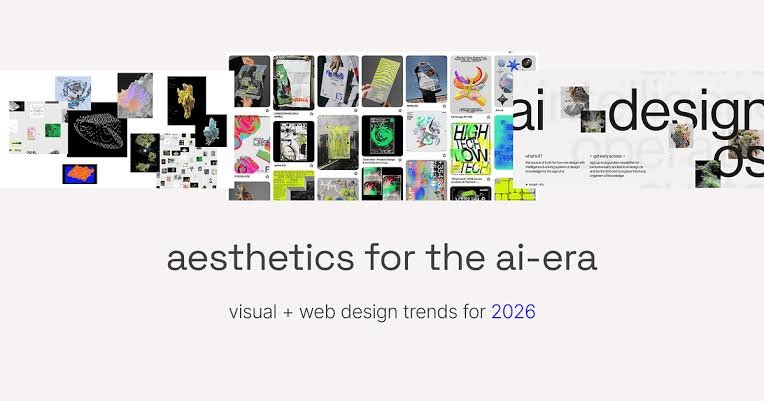
The important change is that AI is increasingly becoming part of the creative process rather than remaining a separate production tool. Canva’s 2026 research describes AI as an important creative partner while also reporting a strong desire among creators to regain creative control. Its research identified ten major visual trends and emphasized the growing importance of imperfection and personal expression.
Synthetic Aesthetics 2026 and AI-Generated Visual Worlds
One of the strongest developments is the creation of visual worlds that would be difficult, expensive, or impossible to produce traditionally. AI can combine futuristic architecture, unusual landscapes, surreal characters, imaginary products, and cinematic environments into a single visual concept Synthetic Aesthetics AI.
This makes synthetic aesthetics particularly useful for advertising, entertainment, fashion, gaming, websites, social media campaigns, and experimental branding. A designer can start with an ordinary concept and transform it into something visually unexpected without building the entire environment physically.
However, originality remains important. If thousands of creators use similar prompts and default settings, their results can begin to look almost identical. This is one reason why creative direction, editing, cultural context, and personal visual identity remain essential Synthetic Aesthetics AI.
Synthetic Aesthetics 2026: Surreal and Dreamlike Design
Surreal visual design is becoming especially relevant because generative AI can create combinations that do not follow ordinary physical rules. Objects can float, landscapes can transform, materials can behave strangely, and familiar environments can become dreamlike Synthetic Aesthetics AI.
Canva’s 2026 trend research identifies “Reality Warp” as a major direction, describing visuals that intentionally blur the boundary between reality and surreal digital imagery. Canva also reports a significant year-over-year increase in searches around liminal and uncanny aesthetics.
This creates an opportunity for designers who want their work to feel memorable rather than predictable. Instead of producing another conventional product image, a brand can create a visual world that communicates emotion, imagination, or curiosity Synthetic Aesthetics AI.
Synthetic Aesthetics 2026 and Surreal Visual Storytelling
Surrealism can also make storytelling more powerful. A single unusual image can communicate an idea that would otherwise require several paragraphs of explanation.
For example, a campaign about digital overload could show a person surrounded by floating notification clouds. A sustainability project could represent a city growing organically from a forest. These concepts can become visual metaphors rather than ordinary illustrations.
Synthetic Aesthetics 2026: Humanized AI Aesthetics
The biggest countertrend to synthetic perfection is humanization. Early AI visuals often became recognizable because they were excessively smooth, symmetrical, glossy, and polished. In 2026, many designers are deliberately introducing imperfections, textures, irregular layouts, handwritten elements, natural lighting, and physical-looking materials Synthetic Aesthetics AI.
Canva describes 2026 as a period of “Imperfect by Design,” while other design research also highlights a movement toward tactile textures and human personality.
Synthetic Aesthetics 2026 and the Return of Imperfection
Imperfection does not necessarily mean poor quality. It can mean adding visual details that communicate human involvement. Slightly uneven typography, rough paper textures, hand-drawn marks, grain, collage elements, natural shadows, and imperfect photography can make digital work feel more authentic.
This approach is especially useful for brands that do not want their content to appear mass-produced. The goal is not to hide the use of AI but to use AI while preserving a recognizable human point of view Synthetic Aesthetics AI.
Synthetic Aesthetics 2026: Tactile and Sensory Visuals
Another important direction is tactile design. Digital images cannot literally be touched, but designers can use texture, lighting, material simulation, and depth to create the visual expectation of touch.
A surface can appear knitted, metallic, ceramic, wooden, rough, soft, wet, or paper-like. These visual signals can create stronger emotional responses than completely flat digital graphics.
Adobe’s 2026 Creative Trends research highlights sensory-driven design alongside emotional connection, surreal visuals, cultural authenticity, and AI-supported creativity Synthetic Aesthetics AI.
Synthetic Aesthetics 2026 and Material-Based Design
Material-based visuals can also help brands differentiate themselves. Instead of using another generic gradient, a designer might build a visual identity around paper, fabric, clay, glass, stone, or handcrafted surfaces.
This creates a useful connection between synthetic technology and physical reality. AI generates the concept, while physical textures make the result feel familiar Synthetic Aesthetics AI.
Synthetic Aesthetics 2026: Dynamic and Adaptive Styles
Traditional visual identities often depend on fixed logos, colors, fonts, and layouts. Synthetic aesthetics can make these systems more flexible Synthetic Aesthetics AI.
AI-assisted design can help generate multiple visual variations while maintaining a central brand identity. A campaign might change its imagery according to location, audience, season, platform, or message.
This creates the possibility of visual identities that are not completely static. Instead, the identity becomes a system capable of adapting to different situations.
Synthetic Aesthetics 2026 and Personalized Visual Experiences
Personalization is another important opportunity. AI can help create visual content for specific audiences rather than forcing every customer to experience exactly the same image Synthetic Aesthetics AI.
A travel company, for example, could create different visual moods for different destinations. A fashion brand could experiment with different cultural references and visual environments while keeping the same core identity.
The challenge is maintaining consistency. Personalization should expand a brand rather than make it visually unrecognizable Synthetic Aesthetics AI.
Synthetic Aesthetics 2026: Retro-Futuristic Visual Language
Another interesting direction combines old and new aesthetics. Designers can mix retro typography, vintage photography, analog textures, pixel graphics, futuristic interfaces, CGI objects, and AI-generated environments.
This creates a retro-futuristic appearance that feels simultaneously familiar and new.
The approach works because nostalgia gives viewers something recognizable while futuristic elements introduce surprise. In an AI-saturated environment, designers can use older visual languages to escape the generic appearance associated with automated content.
Synthetic Aesthetics 2026: Multimodal Creative Design
AI is also bringing image, text, sound, video, and interactive experiences closer together. A creative concept can begin with a written idea and develop into an image, animation, voice experience, website, or interactive environment Synthetic Aesthetics AI.
This means synthetic aesthetics are no longer limited to still images. The same visual language can move across multiple formats.
A successful synthetic identity may therefore include typography, motion, sound, illustration, 3D design, photography, and interactive elements. The strongest systems will maintain recognizable characteristics across all of them.
Synthetic Aesthetics 2026: Authenticity and Human Creativity
Despite rapid AI development, human judgment remains important. AI can generate possibilities, but designers still need to decide which possibilities are meaningful Synthetic Aesthetics AI.
This distinction is becoming more important because audiences are increasingly familiar with AI-generated content. A technically impressive image may not be memorable if it has no clear idea behind it.
Current 2026 design discussions repeatedly point toward authenticity, human expression, imperfection, and emotional connection as responses to overly generic AI visuals.
Synthetic Aesthetics 2026 and Creative Originality
Originality can come from the combination of human experience and AI experimentation. Designers can use personal photography, cultural references, handmade elements, unusual typography, original storytelling, and real-world observations as inputs.
The result can be synthetic in production but human in meaning.
Synthetic Aesthetics 2026: 5 Hidden Challenges
The growth of synthetic aesthetics also creates serious challenges. The first is visual sameness. When many people use similar AI tools, prompts, datasets, and presets, different brands can accidentally produce similar-looking content.
The second challenge is authenticity. Audiences may question whether an image represents a real person, place, product, or event. This can become especially important for advertising, journalism, healthcare, education, and other areas where visual accuracy matters.
The third challenge is intellectual property and likeness. AI-generated visuals can raise questions about training data, recognizable styles, and the use of people’s identities. A recent 2026 advertising case involving an AI-generated likeness of Greta Garbo demonstrates how synthetic media can create both creative possibilities and ethical concerns.
The fourth challenge is environmental impact. Large-scale AI image generation requires computing resources, and researchers and commentators have increasingly raised concerns about the energy and water demands associated with AI infrastructure.
The fifth challenge is creative dependency. If designers rely too heavily on automated generation, they may spend less time developing drawing skills, visual judgment, conceptual thinking, and personal style.
Synthetic Aesthetics 2026 and AI Visual Sameness
Visual sameness may become one of the biggest practical problems. Research and design commentary in 2026 increasingly discuss the recognizable “AI look,” including glossy surfaces, smooth lighting, symmetrical compositions, and overly polished imagery.
The solution is not necessarily to stop using AI. Instead, designers can use AI as a starting point and then add original direction, editing, real-world references, imperfections, and distinctive brand characteristics.
Synthetic Aesthetics 2026: Research Signals
The available 2026 trend research shows a clear tension: AI is becoming more important in creative workflows, while creators are simultaneously looking for greater authenticity and control.
| Research signal | Reported finding | What it means for Synthetic Aesthetics 2026 |
|---|---|---|
| Creative control | 80% | Creators want stronger control over AI-assisted creativity |
| AI as creative partner | 77% | AI is becoming integrated into creative workflows |
| Liminal and uncanny searches | +220% YoY | Surreal and unusual visual languages are gaining attention |
| Humanized design | Growing trend | Imperfection and personality can differentiate AI visuals |
| Sensory design | 2026 trend focus | Texture and emotional connection are becoming more important |
The first three figures above come from Canva’s 2026 design-trend research; the humanized and sensory directions are also reflected in broader 2026 creative-trend reporting.
Synthetic Aesthetics 2026: Future Outlook
The future of synthetic aesthetics is unlikely to be completely artificial or completely human. Instead, the most interesting direction is collaboration. AI can provide speed, variation, experimentation, and visual possibilities, while humans provide context, emotion, taste, ethics, cultural understanding, and final judgment.
This balance is already visible in 2026 design research. Canva’s research emphasizes creative control and imperfection, while Adobe highlights innovation, authenticity, connection, sensory experiences, and surreal experimentation.
Synthetic aesthetics can therefore become more than an AI visual trend. It can become a design approach in which technology expands the creative field while human intention determines what deserves to remain.
Synthetic Aesthetics 2026: Final Thoughts
Synthetic Aesthetics 2026 represents a major shift in visual culture. AI can now generate surreal worlds, tactile surfaces, dynamic identities, personalized graphics, retro-futuristic compositions, and multimodal experiences at remarkable speed. Yet the same technology creates challenges involving sameness, authenticity, ownership, environmental cost, and creative dependency.
The strongest synthetic designs may not be the ones that look the most artificial. They may be the ones that use advanced AI capabilities while retaining something unmistakably human. In 2026, originality may come less from avoiding AI and more from learning how to direct it with a distinctive idea, meaningful context, and authentic creative voice.