
Why Rain-Collecting Facade Designs Matter
Rain-Collecting Facade Designs are changing the way researchers think about the unused surfaces of modern buildings. Traditionally, rainwater harvesting has focused mainly on rooftops, but tall buildings often have enormous vertical surfaces that interact with wind-driven rain. Recent research is exploring how those surfaces can be designed to capture, direct, store, or reuse water rather than simply allowing rainfall to run away. A 2026 systematic review found that rainwater and atmospheric-water harvesting technologies can improve water resilience in housing, particularly where water scarcity and climate variability are concerns.
The idea becomes even more interesting when architecture starts behaving like a water-collecting organism. Instead of adding a large tank or complicated external system, designers can incorporate channels, textured surfaces, adaptive shading, biomimetic patterns, and collection layers directly into the building envelope. A 2026 study investigated a biomimetic adaptive façade inspired by the water-collecting morphology of Lomelosia stellata, showing how a façade could combine water collection with energy and daylight performance.
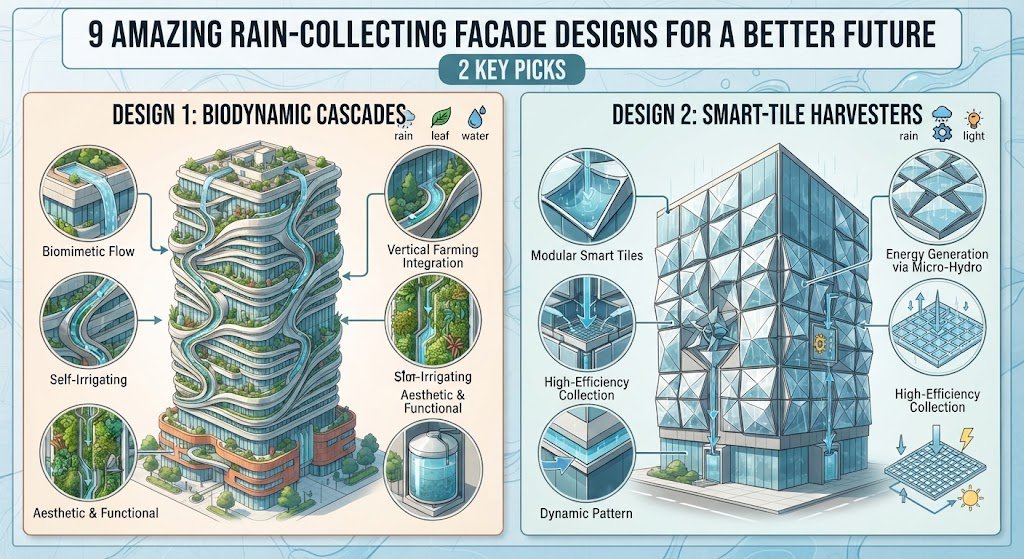
Table of Contents
- What Are Rain-Collecting Facade Designs?
- Why Building Facades Could Become Water Collectors
- 9 Rain-Collecting Facade Designs
- How Biomimicry Is Changing Rain-Collecting Facade Designs
- Why Wind-Driven Rain Matters
- Potential Benefits of Rain-Collecting Facade Designs
- Challenges Researchers Still Need to Solve
- What the Future Could Look Like
- Conclusion
What Are Rain-Collecting Facade Designs?
Rain-Collecting Facade Designs are building-envelope concepts that intentionally capture rainwater falling or being driven against vertical building surfaces. Instead of treating rain as something that must simply be kept outside, these systems explore ways to guide water toward channels, storage systems, irrigation systems, or other non-potable uses.
The concept is particularly interesting for high-rise buildings because their façade area can be much larger than their roof area. Earlier research has already investigated vertical rainwater harvesting from building envelopes, while newer studies are looking at more integrated and adaptive approaches.
This does not mean that every building façade should immediately become a giant water collector. The amount of water available depends heavily on rainfall intensity, wind direction, building orientation, façade geometry, surface material, and local climate.
That is why modern research is increasingly interested in designing the façade itself as part of the water-management system.
Why Rain-Collecting Facade Designs Could Be Important
Rain-Collecting Facade Designs Use Previously Underused Surfaces
A roof is an obvious place for harvesting rain, but vertical surfaces can also encounter substantial wind-driven rainfall. During storms, wind changes the trajectory of raindrops, causing water to strike walls rather than falling vertically.
Research on wind-driven rain shows that façade exposure varies according to wind direction, building geometry, rainfall conditions, and urban surroundings. A 2026 field-and-simulation study examined these effects in an urban street canyon, highlighting how complex rain movement around buildings can be.
This complexity is actually useful for design researchers because it means that façade geometry can potentially be optimized according to local weather.
Rain-Collecting Facade Designs Can Combine Several Functions
The most interesting future façades may not perform only one job.
A façade could potentially provide shade during intense sunlight, guide rainwater during storms, reduce glare, support vegetation, and contribute to cooling. The 2026 biomimetic façade research specifically investigated the combined performance of water collection, energy consumption, and visual comfort.
That multifunctional approach could make water harvesting more attractive than simply adding another piece of equipment to a building.
9 Rain-Collecting Facade Designs for a Better Future
1. Sloped Rain-Collecting Facade Designs
The first approach uses carefully angled façade elements to intercept rain and guide it toward collection channels.
Instead of allowing water to spread randomly across a wall, small slopes can encourage predictable movement. The water can then enter vertical gutters and travel toward a storage tank or filtration system.
This approach is relatively simple compared with highly mechanical systems because the basic movement of water is controlled through geometry.
The important research question is not simply whether water can be collected, but how much water can be captured under different wind and rainfall conditions.
2. Channel-Based Rain-Collecting Facade Designs
Another concept uses narrow channels integrated into the façade.
These channels could function somewhat like miniature streams. Rain striking the surface would enter the channels and move downward under gravity.
The channels could potentially be positioned between façade panels, around windows, or inside architectural shading elements. This could make water collection part of the building’s visual design instead of an obvious external attachment.
Researchers would need to consider cleaning, algae growth, sediment, leakage, maintenance, and freezing in colder climates.
3. Biomimetic Rain-Collecting Facade Designs
One of the most exciting directions is biomimicry, where architectural systems copy useful structures found in nature.
The 2026 biomimetic façade study used Lomelosia stellata as inspiration because of its water-collecting morphology. Its proposed adaptive façade was designed to combine rainwater harvesting with shading and daylight control.
This is important because nature rarely solves only one problem at a time. A plant structure can collect water while also controlling heat and protecting itself from environmental conditions.
Future architecture could use similar principles rather than copying natural shapes purely for appearance.
4. Adaptive Rain-Collecting Facade Designs
Imagine a façade that changes its configuration depending on weather.
During dry weather, façade panels could remain in a position optimized for shade or daylight. During rainfall, selected elements could adjust to intercept more water.
This idea is particularly interesting because the 2026 biomimetic research investigated adjustable shading angles and a mechanically simplified adaptive mechanism that integrates water collection into the shading system.
Such designs could potentially turn a passive wall into a responsive environmental system.
However, moving components introduce additional cost, maintenance, and mechanical complexity.
5. Textured Rain-Collecting Facade Designs
A completely flat wall is not necessarily the best surface for controlling water.
Researchers can explore textures, grooves, ridges, and microstructures that influence how droplets move across a façade.
The challenge is finding a surface that encourages water collection without creating unwanted splash, staining, erosion, or water penetration.
This becomes especially interesting because research on rain impact has shown that droplet size, speed, and impact angle can affect how water behaves when it hits building materials.
Future materials could therefore be designed around droplet behavior, rather than simply being selected for appearance.
6. Rain-Collecting Facade Designs Using Shading Elements
Building shades are normally designed to reduce sunlight and glare, but researchers are exploring whether these components can perform additional functions.
Horizontal overhangs and vertical louvers can interact with wind-driven rain. A 2026 study investigated how façade shading systems consisting of overhangs and vertical louvers affected wind-driven rain and reported substantial mitigation of rain exposure in tested zones.
The same general idea suggests another possibility: shading components could be deliberately shaped to intercept and redirect selected rainfall toward collection points.
This creates an interesting design opportunity where one architectural component performs both climate control and water-management functions.
7. Rain-Collecting Facade Designs Inspired by Desert Plants
Desert plants survive with extremely limited water, making them interesting models for water-collection design.
Some plants have surfaces and structures that influence how water moves toward specific locations. Architects can study these principles to develop façade surfaces that concentrate small amounts of water instead of allowing it to disperse.
This could become particularly useful in semi-arid regions where rainfall is irregular but intense storms can still occur.
The 2026 biomimetic façade research is especially relevant here because its inspiration comes from a plant adapted to arid conditions.
8. Rain-Collecting Facade Designs With Evaporative Cooling
A more unusual approach is to use collected water for cooling rather than treating water harvesting as a separate system.
Hydroactive façade research has explored façade elements that retain rainwater and use delayed evaporation to provide cooling effects. The HydroSKIN concept, for example, combines rainwater retention with evaporative cooling at the building envelope.
This creates a fascinating possibility: the same rainfall could help both water management and thermal management.
However, such systems must be carefully designed to avoid excessive humidity, biological growth, structural problems, and unwanted water retention.
9. Rain-Collecting Facade Designs That Combine Rain and Atmospheric Water
The most futuristic approach may combine conventional rain collection with atmospheric water harvesting.
Atmospheric water harvesting attempts to obtain water from moisture in the air through technologies such as sorption, condensation, fog collection, or related processes. A 2026 systematic review specifically examined the integration of atmospheric water harvesting into building envelopes and described the field as promising but still requiring further investigation for practical building applications.
A future façade could therefore potentially respond to both rainfall and atmospheric moisture, depending on local weather.
That would move architecture beyond simple rainwater harvesting toward a broader concept of a water-responsive building envelope.
How Rain-Collecting Facade Designs Could Work
The basic process can be imagined as a continuous path from sky to storage.
Rain first encounters the façade. Its geometry and surface properties influence whether droplets splash, flow downward, or move sideways. Designed channels or collection surfaces then direct the water toward controlled outlets.
From there, water could pass through filtration and enter storage. Depending on local regulations and treatment quality, harvested water could potentially be considered for non-potable applications such as irrigation, toilet flushing, or cleaning.
Research on rainwater harvesting in university buildings published in 2026 examined its potential for non-potable demands including toilet flushing, lawn irrigation, and vehicle washing.
Rain-Collecting Facade Designs: Research Comparison
The following is an illustrative design comparison, not measured performance data. It shows how different concepts can be compared during early design research.
Illustrative comparison of facade concepts
Conceptual scores for design research only; these are not measured field results.036912
Sloped surfaces
Vertical channels
Biomimetic surface
Adaptive facade
Textured surface
Shading collectors
Evaporative facade
Atmospheric-water facade
Hybrid facade
The comparison shows why hybrid systems are particularly interesting for future research. Instead of asking a façade to perform only one task, researchers can investigate combinations of water collection, shading, cooling, daylight control, and environmental adaptation.
What Makes Rain-Collecting Facade Designs Different From Rooftop Harvesting?
Rooftop harvesting generally depends on horizontal rainfall, while façade harvesting must deal with wind-driven rain.
This difference makes façade systems more complicated.
A vertical wall may receive very different amounts of water depending on its orientation. A façade facing the dominant wind direction could receive more wind-driven rainfall than another side of the same building.
Building height, neighboring structures, balconies, overhangs, surface texture, and local wind patterns can all change the amount and movement of water.
That is why future Rain-Collecting Facade Designs will probably need climate-specific optimization rather than one universal design.
Challenges Facing Rain-Collecting Facade Designs
Maintenance Could Become a Major Problem
Water channels can collect dust, leaves, insects, and other debris. If a system is integrated into a tall building, cleaning those components could become expensive.
Water Quality Needs Attention
Rainwater touching a building surface can collect dust, pollutants, particles, and substances released from coatings or materials. Therefore, collected water cannot automatically be assumed to be suitable for drinking.
Wind Makes Collection Difficult
Wind can push raindrops away from collection surfaces or cause splashing. Urban buildings can also create complex airflow patterns.
Cost Could Limit Adoption
Highly adaptive façades require sensors, moving components, specialized materials, or complex construction. A simple passive design may sometimes provide a more practical solution.
The Climate Must Be Suitable
A façade designed for a rainy climate may have little value in a location with very limited rainfall. Conversely, regions with short intense storms may benefit from designs that rapidly collect and store water.
The Future of Rain-Collecting Facade Designs
The future may not be about choosing between a roof, wall, façade, or atmospheric-water system. Instead, buildings could use multiple surfaces as one integrated water network.
A roof could collect conventional rainfall. A façade could capture wind-driven rain. Shading devices could redirect water. Special materials could retain moisture temporarily. Atmospheric-water technologies could potentially operate during periods without rainfall.
The 2026 research direction is especially interesting because researchers are increasingly looking at these systems as part of the building envelope rather than as completely separate water infrastructure.
This could eventually lead to buildings that respond differently to sunny, rainy, humid, and dry conditions.
Conclusion: Why Rain-Collecting Facade Designs Deserve Attention
Rain-Collecting Facade Designs represent a fascinating shift in architectural thinking. Instead of treating the façade as a passive boundary between indoors and outdoors, researchers are exploring it as an active environmental surface capable of interacting with water, sunlight, wind, and heat.
The most promising concepts combine several functions. Biomimetic surfaces can imitate natural water collection. Adaptive façades can respond to changing conditions. Shading elements can potentially control both sunlight and rain. Hydroactive systems can connect water retention with evaporative cooling.
Research published in 2026 shows that these ideas are moving beyond pure speculation, although many challenges around cost, durability, water quality, maintenance, and real-world performance remain.
The most interesting future may therefore be a building that does not simply keep rain out—but intelligently decides where that rain should go.