
Table of Contents
- Introduction to Museum Design Research
- Museum Design Research and the Visitor Journey
- Museum Design Research and Wayfinding
- Museum Design Research and Accessibility
- Museum Design Research and Lighting
- Museum Design Research and Sensory Experiences
- Museum Design Research and Interactive Exhibits
- Museum Design Research and Comfortable Spaces
- Museum Design Research and Visitor Feedback
- Museum Design Research and the Future of Exhibitions
- Conclusion
Introduction to Museum Design Research
Museum Design Research is changing the way museums think about exhibitions, galleries, entrances, signs, lighting, seating, accessibility, and visitor movement. A museum is no longer simply a place where objects are placed behind glass. Modern exhibition design increasingly considers how visitors move, understand information, interact with objects, and experience a space. Research from museum professionals and visitor studies shows that design decisions can influence navigation, accessibility, comfort, engagement, and the overall experience.
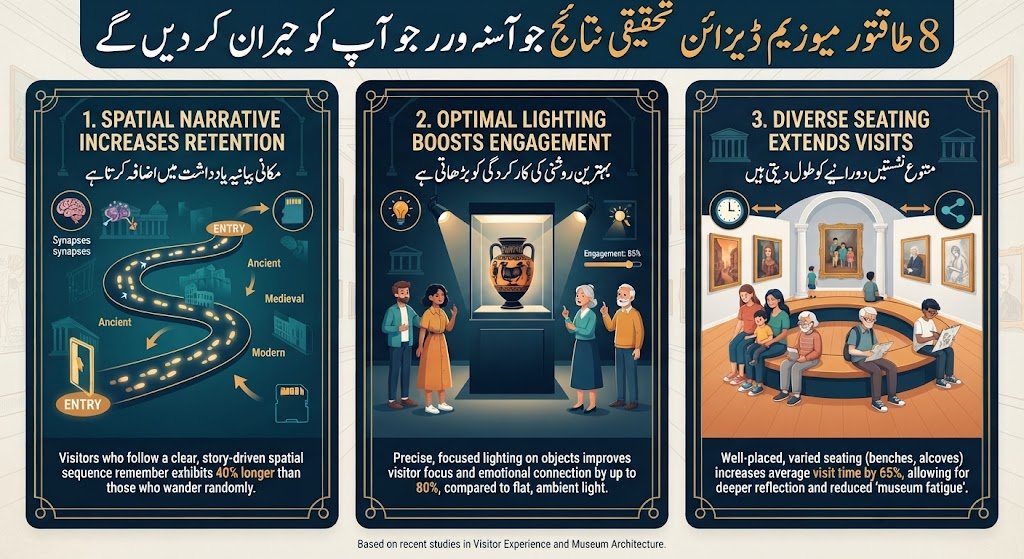
This makes museum design an interesting research field because even small details can affect how people experience an exhibition. The position of a label, the direction of a pathway, the contrast between objects and backgrounds, the amount of seating, and the use of sound can all become part of the visitor experience.
The most interesting part is that good museum design is not always about making a gallery look impressive. It can also be about making the space easier to understand, easier to navigate, more accessible, and more comfortable for different types of visitors.
Museum Design Research and the Visitor Journey
One of the major themes in Museum Design Research is the idea of designing around the visitor journey. Traditional exhibition planning often focused heavily on the collection itself, but contemporary museum practice increasingly considers what visitors experience from the moment they enter until they leave.
The visitor journey can include the entrance, orientation area, first exhibit, pathways, interpretation panels, interactive elements, seating areas, and exit. Each part can influence what happens next. Museums Association research and professional discussions describe exhibition design as increasingly focused on the visitor experience rather than simply displaying objects.
This approach means designers may ask questions such as whether visitors immediately understand where to go, whether the exhibition has a clear story, and whether visitors can take breaks when they need them. These questions turn museum design into a combination of architecture, communication, psychology, accessibility, and storytelling.
A visually beautiful exhibition can still become difficult to experience if visitors cannot understand the layout. For this reason, visitor movement has become an important part of exhibition planning.
Museum Design Research and Wayfinding
Museum Design Research also shows why wayfinding deserves more attention than simply placing arrows on walls. Wayfinding is the process visitors use to understand where they are, where they want to go, and how to reach that destination.
Museums can use signs, maps, architectural features, color differences, landmarks, staff assistance, and digital tools to support navigation. The Museums Association notes that wayfinding can be functional, emotional, and interactive, and that signage, maps, guides, and visitor engagement can work together to shape the experience.
A complicated museum building can make navigation particularly difficult. Historical buildings may have multiple entrances, extensions, unusual floor levels, or corridors that were never designed for modern visitor circulation. In such situations, adding more signs may not completely solve the problem. Designers may first need to understand how people actually move through the space.
This is why research and observation are useful. Instead of assuming where visitors will walk, museums can study real visitor behavior and use those findings to improve the layout.
Museum Design Research and Accessibility
Accessibility is one of the most important areas of Museum Design Research. An exhibition should not be designed only for visitors who can see, hear, walk, or process information in the same way.
Research and professional guidance have highlighted features such as clear pathways, readable signage, sufficient lighting, contrast, accessible seating, audio description, tactile information, and sensory maps. The American Alliance of Museums specifically discusses intuitive layouts, clear signage, marked entrances, appropriate lighting, and safe navigation for visitors with vision loss.
Sensory maps are another interesting development. A 2024 museum accessibility article describes sensory maps as layouts that identify areas with different levels and types of sensory stimulation, allowing visitors to make informed choices about where they want to go.
This represents a broader change in design thinking. Accessibility is increasingly considered as part of the design process rather than something added after an exhibition has already been completed.
Museum Design Research and Lighting
Lighting is another fascinating subject within Museum Design Research because museums must balance two different requirements. Visitors need enough light to see objects and information, while sensitive collections may require careful control of light exposure.
Museum conservation research explains that lighting decisions can depend on the sensitivity of the object, the amount of exposure, and the visual requirements of the visitor.
This means there is no simple rule that every museum object should receive the same level of brightness. Paintings, textiles, photographs, manuscripts, sculptures, and other materials can respond differently to light.
Lighting can also influence how a gallery feels. A dark environment may create a particular atmosphere for a specific exhibition, while brighter illumination can support visibility and movement. The challenge is to create a visual experience without unnecessarily exposing sensitive collections to damaging light.
Therefore, museum lighting is both a design decision and a conservation decision.
Museum Design Research and Sensory Experiences
Modern Museum Design Research increasingly considers experiences beyond ordinary visual displays. Sound, touch, movement, texture, vibration, and other sensory elements can create additional ways for visitors to understand an exhibition.
The Smithsonian’s Cooper Hewitt explored this approach through its “The Senses: Design Beyond Vision” exhibition. The exhibition incorporated tactile maps, braille, audio descriptions, vibrations, and other sensory approaches to create more accessible experiences.
This type of design can be especially meaningful for visitors who cannot experience an exhibition primarily through vision. At the same time, multisensory design can provide additional ways for other visitors to engage with objects and ideas.
However, sensory design also needs careful planning. Too much sound, movement, flashing light, or other stimulation can become uncomfortable for some visitors. Recent museum accessibility research therefore emphasizes giving visitors information and choices about sensory environments.
Museum Design Research and Interactive Exhibits
Interactive exhibits have become another important topic in Museum Design Research. Touchscreens, projections, digital installations, robots, audio systems, and interactive objects can encourage visitors to spend more time engaging with an exhibition.
But research suggests that simply adding technology does not automatically improve learning or visitor experience. The technology needs to have a meaningful purpose.
A Smithsonian evaluation of a pilot Pepper robot program found that visitors were often attracted to the robot because it was unusual and entertaining, while its usefulness as an information source was more limited. The evaluation also found that multiple users, background noise, and lighting conditions could affect its performance.
This is an important design lesson. Technology should solve a real visitor need instead of being included simply because it looks futuristic.
An interactive display can be valuable when it helps visitors understand an object, explore information, hear a story, or experience something that would otherwise be difficult to communicate.
Museum Design Research and Comfortable Spaces
Comfort is another major part of Museum Design Research. Visitors may spend a long time walking through large galleries, standing near displays, reading labels, and moving between rooms. Physical comfort can therefore affect the overall experience.
A Smithsonian exhibition quality study identified comfort factors including ease of wayfinding, ease of movement, accessible seating, appropriate temperature, sound control, lighting, and well-maintained interactive and exhibition elements.
Seating is particularly interesting because it can serve more than one purpose. A visitor may need to rest physically, but seating can also give people time to observe an artwork, read information, or discuss what they have seen.
The placement of seating can therefore influence how a gallery is experienced. A bench placed in the right location can encourage visitors to pause instead of simply walking from one object to another.
Comfort should not be treated as separate from exhibition design. It can become part of the visitor journey itself.
Museum Design Research and Visitor Feedback
One of the strongest ideas in Museum Design Research is that designers should test their assumptions with real visitors. Instead of deciding everything from behind a desk, museums can observe visitors, conduct surveys, organize interviews, and test prototypes.
A good example comes from the Dallas Museum of Art’s “speechless” exhibition, which experimented with multisensory approaches. The visitor research included a 17-question survey completed by 235 adult visitors, followed by interviews with eight respondents. In that particular study, 82% of surveyed visitors gave the exhibition a positive rating. The study also reported positive ratings from 80% of respondents who said they had a child with a disability and 73% of respondents who reported having a disability themselves.
These figures should be understood as findings from that specific exhibition evaluation, not as a universal measurement of museum design.
Museum Design Research Graph: Visitor Evaluation
The following graph represents the three reported positive-rating figures from that specific study.
Research like this gives museums something valuable: evidence about how visitors actually respond. It can reveal whether a design idea is working, whether visitors understand an exhibition, and whether accessibility features are genuinely useful.
Museum Design Research and Inclusive Exhibition Planning
Inclusive planning is becoming a central theme in Museum Design Research. Instead of creating a standard exhibition and adding accessibility features afterward, museums can involve people with different access needs during the design process.
Recent museum practice has included testing artwork height, label placement, circulation space, and seating with people with and without disabilities. A Walker Art Center case study describes using feedback sessions with participants to inform exhibition guidelines for elements such as hanging height, label design, seating, and pathways.
This approach can reveal details that professional designers may overlook. A person using a wheelchair may experience a display differently from a standing visitor. Someone with low vision may need different contrast or text arrangements. A visitor sensitive to noise may experience a crowded sound environment differently from another visitor.
Design research therefore becomes more useful when it includes diverse perspectives.
Museum Design Research and the Future of Exhibitions
The future of Museum Design Research is likely to involve even greater attention to personalization, accessibility, visitor behavior, and flexible exhibition spaces.
Digital tools may support navigation, interpretation, audio experiences, and accessible information. At the same time, physical design will remain important because visitors still need clear paths, comfortable spaces, appropriate lighting, readable information, and meaningful interaction with objects.
The Smithsonian’s work on inclusive digital interactives emphasizes that wayfinding technologies can be designed around the needs of people with different physical and cognitive access requirements.
The future museum may therefore be less about creating one fixed experience for everyone and more about creating an environment in which different visitors can choose how they want to explore.
Museum Design Research: Key Design Factors
| Museum design factor | What research focuses on | Why it matters |
|---|---|---|
| Wayfinding | Signs, maps, routes and orientation | Helps visitors understand where to go |
| Accessibility | Contrast, tactile information and clear paths | Supports visitors with different access needs |
| Lighting | Visibility and collection protection | Balances visitor needs with conservation |
| Seating | Rest and observation areas | Supports physical comfort and longer engagement |
| Sensory design | Sound, touch, movement and visual stimulation | Creates additional ways to experience exhibits |
| Interactivity | Digital and physical interaction | Can support engagement when purposefully designed |
| Visitor research | Surveys, observation and testing | Shows how real visitors respond |
| Flexible design | Adaptable layouts and information | Helps museums respond to changing visitor needs |
Conclusion
Museum Design Research reveals that successful museum experiences depend on much more than attractive architecture or valuable collections. Wayfinding, lighting, accessibility, seating, sensory design, interactive technology, and visitor feedback can all influence how people experience an exhibition.
The most interesting finding is that small design decisions can have surprisingly large effects on the way visitors move, understand, and interact with a museum. Research also shows that museums can improve their designs by testing ideas with real visitors rather than relying only on assumptions.
As museums continue to experiment with multisensory experiences, digital tools, inclusive layouts, and flexible exhibition spaces, Museum Design Research will remain an important field for understanding how physical environments can connect people with culture, history, science, and art in more meaningful ways.