
Table of Contents
- Introduction to Miyawaki Forest Ideas
- Choose the Right Native Plants
- Build Layers for Natural Growth
- Prepare the Soil Before Planting
- Use Dense Planting for Faster Results
- Add Water-Smart Miyawaki Forest Ideas
- Protect Young Plants Naturally
- Avoid Common Miyawaki Forest Mistakes
- Long-Term Care and Growth
- Conclusion
Introduction to Miyawaki Forest Ideas
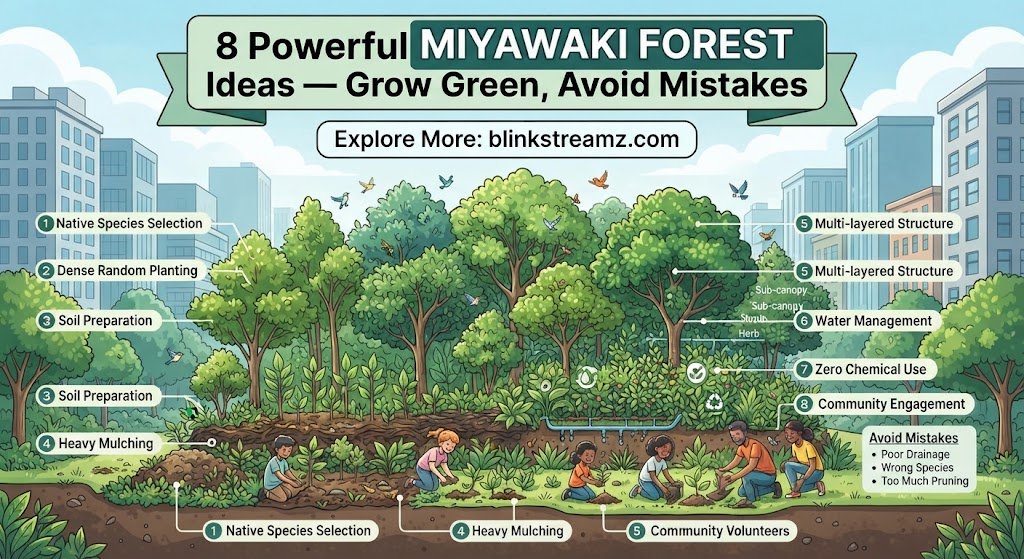
Miyawaki Forest Ideas are becoming an interesting approach for creating dense, nature-focused green spaces in areas where traditional forests cannot easily grow. Instead of depending on large areas of land, the Miyawaki method focuses on native plants, healthy soil, close planting, and multiple layers of vegetation. This approach can be adapted to small urban plots, school grounds, community spaces, unused land, and other compact outdoor areas. When planned carefully, Miyawaki Forest Ideas can turn an ordinary piece of land into a visually rich and biodiversity-friendly landscape.
The basic concept is strongly connected with the Japanese botanist Akira Miyawaki, whose planting method emphasized native vegetation and natural forest development. Today, the idea is being adapted in different climates and urban environments. However, a successful mini-forest is not simply about planting many trees together. Soil preparation, plant selection, maintenance, moisture management, and local climate all matter.
Why Miyawaki Forest Ideas Work Differently
Traditional landscaping often separates trees, shrubs, flowers, and groundcover into clearly defined areas. Miyawaki Forest Ideas take a different approach by creating several vegetation layers close together. Young plants compete for sunlight and space while developing a dense green structure.
The method generally attempts to recreate some characteristics of a young natural forest. The planting area may contain taller trees, smaller trees, shrubs, and ground-level vegetation. This layered structure can make a small landscape appear much denser than a conventional tree plantation.
The important point is that the method should be adapted to local conditions instead of copied blindly. A plant that performs well in one country may struggle in another climate. For a Pakistani urban site, for example, locally suitable native or well-adapted species should be investigated before planting.
Miyawaki Forest Ideas for Choosing Native Plants
One of the most important Miyawaki Forest Ideas is to start with the plants that naturally belong to the local ecosystem. Native species are generally more connected to local climate conditions, soil characteristics, insects, birds, and other organisms.
Instead of selecting plants simply because they look attractive, research should focus on their mature height, root behavior, water requirements, sunlight tolerance, and local suitability. A combination of trees, shrubs, and ground vegetation can create a more natural structure.
A useful planting design can include taller canopy species toward the upper layer, smaller trees beneath them, shrubs in the middle layer, and low-growing plants near the ground. This creates visual depth while making better use of vertical space.
Miyawaki Forest Ideas for Creating Natural Plant Layers
Another valuable approach among Miyawaki Forest Ideas is designing the planting area vertically rather than treating it as a flat garden. A forest naturally contains different heights, and this principle can be recreated on a smaller scale.
The tallest plants form the future canopy. Medium-height trees occupy the next layer, while shrubs and groundcover create lower vegetation. This layered structure can make the site look fuller and more natural as it develops.
The important thing is not to make every plant identical in height or spacing. A slightly irregular arrangement can create a more natural appearance. At the same time, the planting density needs to be practical enough that plants have an opportunity to establish healthy roots.
Miyawaki Forest Ideas for Healthy Soil Preparation
Healthy soil is one of the foundations of successful Miyawaki Forest Ideas. Young plants need suitable soil conditions before they can develop strong roots. Simply digging holes and placing seedlings into poor soil may produce disappointing results.
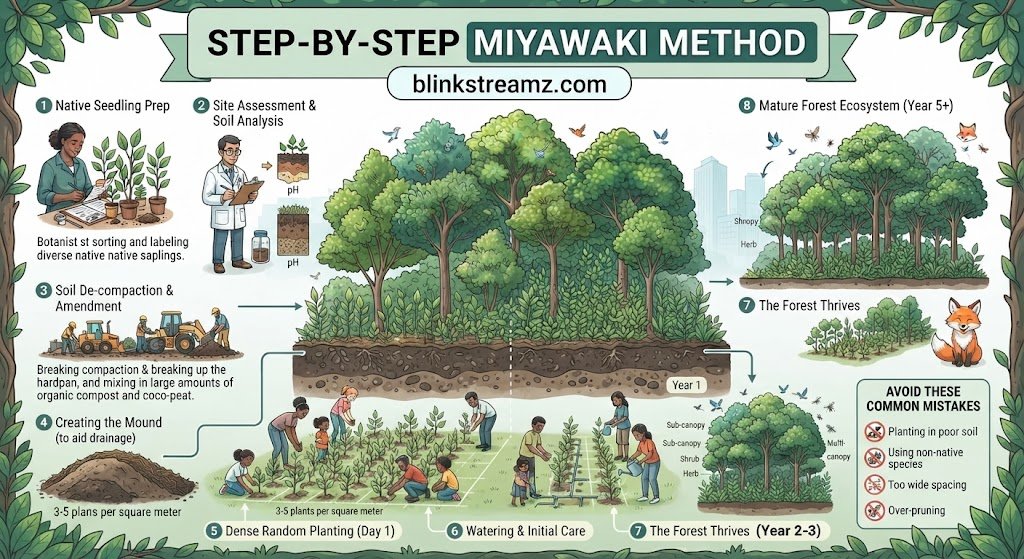
Before planting, the soil should be examined for drainage, compaction, organic matter, and general fertility. Compacted ground may need to be loosened so roots can expand more easily. Organic material can also be incorporated when appropriate for the local soil and plant selection.
Soil preparation should be based on actual site conditions rather than using the same formula everywhere. Excessive fertilizer can also create problems, so the goal should be a healthy growing environment rather than simply adding as many nutrients as possible.
Miyawaki Forest Ideas for Dense Planting
Dense planting is one of the features that makes Miyawaki Forest Ideas visually different from conventional landscaping. Instead of leaving large spaces between young trees, plants are generally positioned relatively close together.
The purpose is to create a dense developing vegetation structure. As the plants grow, their leaves and branches begin to occupy different layers of the planting area.
However, dense planting does not mean randomly filling every available space. The final plant size, root behavior, local rainfall, soil quality, and maintenance requirements should be considered before determining spacing.
Miyawaki Forest Ideas for Water-Smart Growth
Water management is another important part of Miyawaki Forest Ideas, especially in regions where summers can be hot or rainfall can be inconsistent. Young plants usually require more attention during establishment than mature vegetation.
Mulching can help reduce evaporation from the soil surface and protect young roots from extreme temperature changes. Watering should focus on supporting establishment rather than creating permanently waterlogged soil.
The exact watering schedule depends on rainfall, soil type, temperature, plant species, and season. A site in a dry urban environment may require a different approach from a location with regular rainfall.
Miyawaki Forest Ideas for Protecting Young Plants
Young vegetation can face competition from weeds, extreme weather, animals, and human activity. Good Miyawaki Forest Ideas therefore include protection during the early establishment period.
A simple physical boundary can prevent accidental trampling. Mulch can reduce unwanted vegetation around young plants, while regular observation can identify damaged or struggling seedlings before the problem becomes larger.
Protection should gradually become less intensive as the vegetation becomes established. The long-term goal is to allow the planted ecosystem to become increasingly self-supporting.
Miyawaki Forest Ideas for Avoiding Common Mistakes
Some common mistakes can reduce the effectiveness of Miyawaki Forest Ideas. One major mistake is selecting plants only according to appearance instead of ecological suitability. Another is ignoring soil preparation.
Planting too many unsuitable species can also create long-term maintenance problems. Similarly, assuming that every Miyawaki forest will grow rapidly without maintenance can lead to unrealistic expectations.
Another issue is copying a planting formula from a different climate. A successful project should reflect local rainfall, temperature, soil, native vegetation, and available space. The method is a framework, not a universal one-size-fits-all recipe.
Miyawaki Forest Ideas for Long-Term Growth
The early stage of a mini-forest requires the most attention, but long-term observation remains useful. Plants should be monitored for growth, drought stress, disease, physical damage, and competition.
As vegetation develops, the appearance of the site may change significantly. Plants that initially seem small can eventually create a dense canopy. Ground vegetation may also become less visible as taller plants expand.
The long-term design should therefore allow natural development instead of trying to keep everything permanently controlled. Occasional maintenance may still be necessary, particularly in highly urban locations.
Illustrative Growth Comparison
The following chart is an illustrative planning example, not measured scientific data. It shows how a dense planting concept may visually develop over time.
Conclusion: Miyawaki Forest Ideas for Greener Spaces
Miyawaki Forest Ideas offer a creative way to think about small-scale urban planting. Instead of treating trees as isolated decorative elements, the approach focuses on creating a dense, layered vegetation system using locally suitable plants and carefully prepared soil.
The strongest results come from understanding the local environment rather than simply copying another project’s design. Native plant selection, soil preparation, planting density, water management, early protection, and long-term observation all contribute to the development of a healthier green space.
For homeowners, schools, communities, and designers with limited land, the Miyawaki concept can provide an interesting framework for transforming underused outdoor areas. With realistic expectations and careful planning, even a compact plot can become a visually rich piece of urban greenery.