
Buildings Cool Without AC is becoming an increasingly interesting area of design research as architects and researchers look for ways to reduce indoor heat without depending completely on mechanical cooling. Instead of using more electricity to fight rising temperatures, modern building design can work with sunlight, wind, shade, materials, vegetation, and the shape of a structure. These ideas are often connected with passive cooling, climate-responsive architecture, and energy-efficient design. In 2026, these approaches are attracting attention because reducing cooling demand can make buildings more comfortable while also reducing energy consumption 7 Powerful Designs That Keep Buildings Cool Without AC.
Table of Contents
- Why Buildings Cool Without AC Is Becoming Important
- Buildings Cool Without AC Through Natural Airflow
- Buildings Cool Without AC With External Shading
- Buildings Cool Without AC Through Reflective Roofs
- Buildings Cool Without AC Using Thermal Mass
- Buildings Cool Without AC With Green Design
- Buildings Cool Without AC Through Smart Window Design
- Buildings Cool Without AC With Courtyards
- Research Trends Behind Buildings Cool Without AC
- The Future of Buildings Cool Without AC
- Conclusion
Why Buildings Cool Without AC Is Becoming Important
The idea behind Buildings Cool Without AC is not necessarily to make every building completely independent of air conditioning. Instead, the goal is to reduce the amount of heat entering a building and improve the movement of naturally cooler air. When a building is designed correctly, cooling systems may not need to work as hard during many parts of the day 7 Powerful Designs That Keep Buildings Cool Without AC.
Traditional buildings can absorb large amounts of solar radiation through roofs, walls, windows, and exposed outdoor surfaces. During hot weather, this stored heat can gradually move indoors. A poorly positioned window can also allow strong afternoon sunlight to turn a room into a heat trap. Passive design attempts to solve these problems before mechanical cooling becomes necessary.
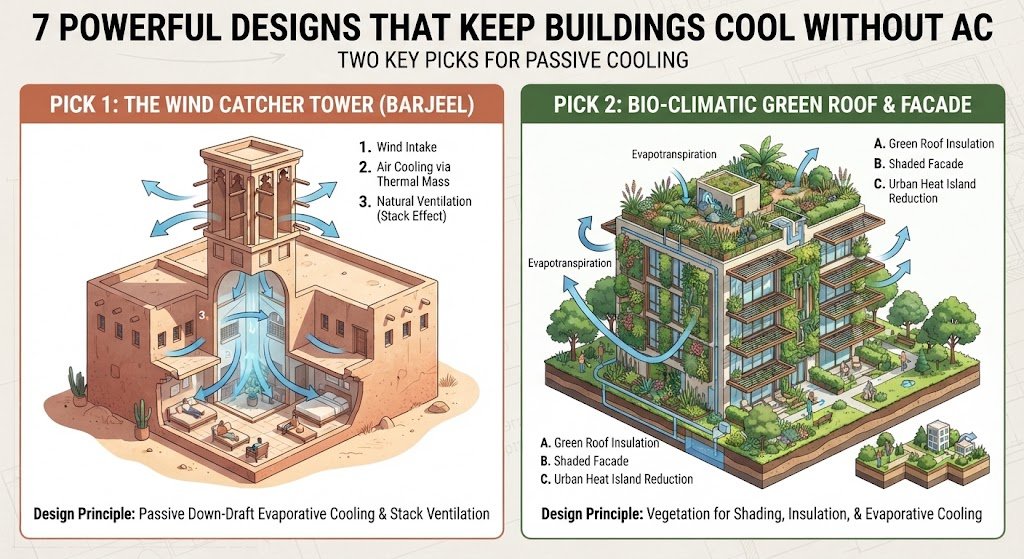
This makes Buildings Cool Without AC an interesting research topic because the solution is often found in the structure itself rather than in another electrical device.
Buildings Cool Without AC Through Natural Airflow
One of the oldest ways to create Buildings Cool Without AC is natural ventilation. Long before modern air conditioners existed, people designed buildings around wind direction, openings, courtyards, high ceilings, and narrow passages 7 Powerful Designs That Keep Buildings Cool Without AC.
When warm indoor air rises, carefully positioned openings near the upper part of a building can allow that heat to escape. Lower openings can bring in outdoor air when conditions are suitable. This movement can create a natural airflow cycle without requiring a powered fan.
Cross ventilation is another important design strategy. Windows or openings placed on opposite sides of a room can allow air to enter from one side and leave through another. The effectiveness depends on outdoor temperature, wind speed, humidity, building orientation, and the size and position of openings.
Buildings Cool Without AC With Stack Ventilation
Stack ventilation uses differences in air temperature. Warm air naturally becomes less dense and rises. If a building includes a taller ventilation path, the warm air can escape upward while cooler air enters from lower openings.
Some contemporary designs use atriums, ventilation towers, roof openings, and high-level windows to strengthen this effect. These systems show how basic physical principles can become part of architectural design.
Buildings Cool Without AC With External Shading
Another powerful method for creating Buildings Cool Without AC is stopping sunlight before it reaches the building envelope. External shading can include balconies, overhangs, louvers, pergolas, screens, shutters, and vegetation 7 Powerful Designs That Keep Buildings Cool Without AC.
This approach is especially useful because preventing solar heat from entering is generally more effective than trying to remove the heat after it has already entered a room.
Horizontal overhangs can be useful where high-angle sunlight is a major problem, while vertical fins can help control lower-angle sunlight from the sides. Some modern buildings combine several shading elements to respond to different sun positions throughout the day.
Buildings Cool Without AC With Adjustable Shading
Research and contemporary design are also exploring adjustable shading systems. Instead of keeping a fixed screen in one position, movable elements can respond to sunlight and environmental conditions.
7 Powerful Designs That Keep Buildings Cool Without AC These systems can potentially improve daylight while reducing unwanted solar heat. The design challenge is finding the right balance between natural light, visibility, heat protection, and energy performance.
Buildings Cool Without AC Through Reflective Roofs
Roofs receive intense solar radiation, particularly in hot and sunny climates. This makes roof design one of the most important areas for Buildings Cool Without AC.
A reflective or “cool” roof can reflect a greater portion of incoming solar radiation instead of absorbing it. Light-colored or specially engineered roofing surfaces can therefore remain cooler under strong sunlight than darker surfaces with higher solar absorption.
Roof insulation adds another layer of protection. Even when the outside roof becomes hot, good insulation can slow the movement of heat toward interior spaces 7 Powerful Designs That Keep Buildings Cool Without AC.
Buildings Cool Without AC With Roof Ventilation
Ventilated roof systems can create another cooling layer. If hot air is allowed to move through a cavity beneath the outer roof surface, some of the accumulated heat can be removed before it reaches the occupied space 7 Powerful Designs That Keep Buildings Cool Without AC.
Combining reflective surfaces, insulation, and ventilation can make roof design an important part of a passive cooling strategy 7 Powerful Designs That Keep Buildings Cool Without AC.
Buildings Cool Without AC Using Thermal Mass
Thermal mass is another fascinating concept behind Buildings Cool Without AC. Materials such as concrete, brick, stone, and other dense construction materials can absorb and store heat.
The important factor is not simply having heavy materials. Their effectiveness depends on climate, insulation, ventilation, building orientation, and when the stored heat is released 7 Powerful Designs That Keep Buildings Cool Without AC.
In some climates, thick walls can delay the movement of daytime heat toward interior spaces. If the building can release stored heat during cooler nighttime conditions, the cycle can help stabilize indoor temperatures.
This concept has been used in traditional architecture for centuries, but modern researchers continue to study how thermal mass can be combined with insulation and passive ventilation 7 Powerful Designs That Keep Buildings Cool Without AC.
Buildings Cool Without AC With Green Design
Vegetation can also contribute to Buildings Cool Without AC. Trees, climbing plants, green walls, and green roofs can change the thermal environment around a structure 7 Powerful Designs That Keep Buildings Cool Without AC.
A large tree positioned near a building can block direct solar radiation from walls and windows. Plants can also influence the surrounding microclimate through evapotranspiration, in which water moves from vegetation into the atmosphere.
Green roofs provide another interesting design strategy. Vegetation and growing media can add insulation and alter the temperature of the roof surface. Their performance depends on plant selection, climate, irrigation, roof construction, and maintenance.
Buildings Cool Without AC With Green Roofs
Green roofs should not be treated as a universal replacement for air conditioning. Their performance varies significantly between climates and building designs. However, they can become one component of a broader passive cooling strategy 7 Powerful Designs That Keep Buildings Cool Without AC.
A building that combines a green roof with shading, insulation, natural ventilation, and reflective surfaces can approach cooling as a complete design problem rather than relying on one technology A building that combines a green roof with shading, insulation, natural ventilation, and reflective surfaces can approach cooling as a complete design problem rather than relying on one technology .
Buildings Cool Without AC Through Smart Window Design
Windows are essential for daylight and ventilation, but they can also become major sources of unwanted heat. This makes window design an important part of Buildings Cool Without AC.
The size, orientation, glazing type, position, and shading of windows can influence indoor temperature. Large unshaded windows facing strong afternoon sunlight may create substantial solar heat gain.
Modern architectural research therefore looks at glazing performance, shading devices, window placement, and daylight optimization together 7 Powerful Designs That Keep Buildings Cool Without AC.
A well-designed window does not simply provide a view. It can become part of the building’s strategy for controlling sunlight, airflow, and indoor comfort.
Buildings Cool Without AC With Courtyards
Courtyards provide another fascinating approach to Buildings Cool Without AC. Traditional architecture in many hot regions has used enclosed or semi-enclosed courtyards to create shaded outdoor spaces and improve air movement 7 Powerful Designs That Keep Buildings Cool Without AC.
A courtyard can reduce direct solar exposure when walls and vegetation provide shade. Depending on its geometry and local climate, it can also influence airflow and nighttime cooling.
Modern architects are revisiting courtyard concepts because they can combine social space, daylight, vegetation, and passive environmental control within one architectural feature.
Buildings Cool Without AC With Water and Vegetation
Some courtyard designs include vegetation or carefully managed water features. Evaporation can potentially influence the surrounding air temperature, although the effect depends strongly on humidity, airflow, water availability, and climate 7 Powerful Designs That Keep Buildings Cool Without AC.
The important lesson is that passive cooling works as a system. A courtyard becomes more useful when its orientation, shading, openings, materials, and vegetation are designed together 7 Powerful Designs That Keep Buildings Cool Without AC.
Research Trends Behind Buildings Cool Without AC
Current research into Buildings Cool Without AC increasingly focuses on combining multiple passive strategies rather than depending on one solution. Computer simulations, climate data, building sensors, and environmental modeling can help researchers test how buildings respond to different weather conditions.
The following simplified comparison shows how different design strategies can contribute to reducing indoor heat exposure. The values are illustrative rather than universal performance measurements because actual results vary by climate and building type 7 Powerful Designs That Keep Buildings Cool Without AC.
| Design Strategy | Main Cooling Principle | Heat-Control Potential | Common Design Use |
|---|---|---|---|
| External shading | Blocks solar radiation | High | Windows and facades |
| Natural ventilation | Moves warm air out | High | Windows and ventilation openings |
| Reflective roof | Reflects sunlight | High | Roof surfaces |
| Thermal mass | Delays heat transfer | Medium to High | Walls and floors |
| Green roof | Shade and thermal buffering | Medium | Roofs |
| Courtyard | Shade and airflow | Medium to High | Homes and public buildings |
| Window optimization | Controls sunlight and airflow | High | Building facades |
Buildings Cool Without AC Research Comparison
A simple conceptual graph can show how several passive strategies can contribute to cooling performance. This is a conceptual research illustration, not measured universal data.
Relative Cooling Contribution

External Shading       ██████████
Natural Ventilation    █████████
Reflective Roof        ████████
Window Optimization    ████████
Thermal Mass           ███████
Courtyard Design       ███████
Green Roof             ██████
The graph highlights an important idea: no single design automatically works everywhere. A strategy that performs strongly in a dry climate may behave differently in a hot and humid environment. Building orientation, local weather, construction materials, occupancy, and maintenance all influence the final result 7 Powerful Designs That Keep Buildings Cool Without AC.
The Future of Buildings Cool Without AC
The future of Buildings Cool Without AC is likely to involve combinations of passive design and carefully controlled technology. The goal is not necessarily to remove every cooling machine from every building. Instead, future architecture can reduce the amount of cooling required in the first place 7 Powerful Designs That Keep Buildings Cool Without AC.
Digital modeling can help architects test sunlight, airflow, thermal behavior, and shading before construction begins. Sensors can also provide information about indoor temperature, humidity, and outdoor conditions, allowing building systems to respond more efficiently.
One interesting direction is climate-responsive architecture, where a building is designed specifically around the environmental conditions of its location. Instead of copying the same building style everywhere, architects can consider local wind patterns, solar angles, rainfall, vegetation, building materials, and seasonal temperature changes 7 Powerful Designs That Keep Buildings Cool Without AC.
This approach could make Buildings Cool Without AC more practical because the design is adapted to the environment rather than treating every climate in the same way.
Conclusion: Buildings Cool Without AC Could Shape Smarter Design
Buildings Cool Without AC represents a design philosophy in which architecture itself becomes part of the cooling system. Natural airflow, external shading, reflective roofs, thermal mass, vegetation, optimized windows, and courtyards can all influence how much heat enters and remains inside a building.
The most interesting aspect is that many of these ideas are not completely new. Traditional buildings around the world developed ingenious responses to local climates long before modern air conditioning. What is changing in 2026 is the ability to combine traditional passive principles with modern materials, digital simulation, environmental sensors, and advanced architectural research 7 Powerful Designs That Keep Buildings Cool Without AC.
Rather than asking only how to cool a building after it becomes hot, designers can ask a more fundamental question: how can the building be designed so that less heat enters in the first place? That shift in thinking could make future architecture more comfortable, energy-conscious, and responsive to its surrounding environment 7 Powerful Designs That Keep Buildings Cool Without AC.