
Drone Design Innovations are changing the way unmanned aircraft are built, controlled, and used in the real world. Modern drones are no longer designed only to fly, carry a camera, and follow a remote-control command. Engineers are developing aircraft that can change shape, navigate without traditional GPS, carry interchangeable payloads, use advanced lightweight materials, and make faster decisions in complex environments. Recent research is also exploring tactile sensing, deformable structures, nature-inspired flight, and autonomous navigation systems.
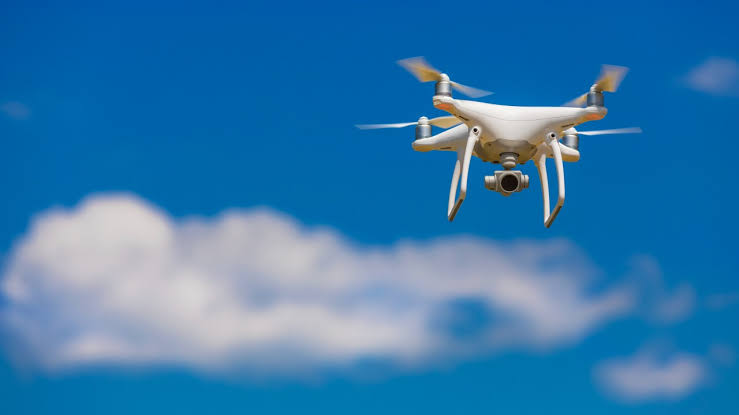
The growing importance of Drone Design Innovations comes from a simple engineering challenge: drones must become smaller, lighter, safer, smarter, and more adaptable without sacrificing flight performance. From search-and-rescue operations to infrastructure inspection and environmental monitoring, new designs are opening possibilities that were difficult for conventional drones to achieve.
Table of Contents
- Why Drone Design Innovations Matter
- Foldable and Deformable Drone Designs
- Lightweight Drone Design Innovations
- Modular Drone Design Innovations
- Tactile Navigation Drone Design
- Advanced Obstacle-Avoidance Design
- Nature-Inspired Drone Design Innovations
- Energy-Efficient Drone Design
- Autonomous Navigation and Smart Control
- Future of Drone Design Innovations
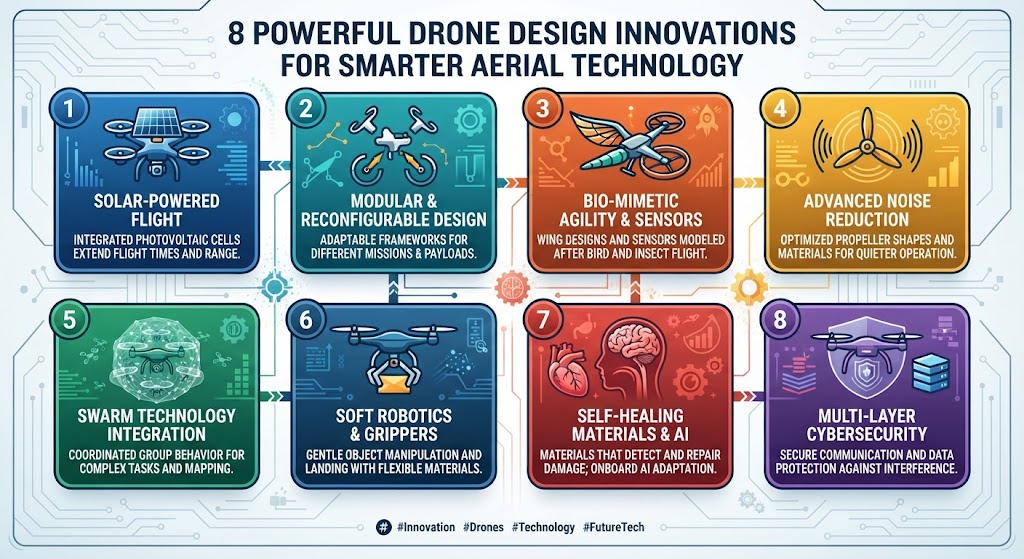
Why Drone Design Innovations Matter
Traditional drone designs usually depend on a fixed frame, electric motors, batteries, cameras, and satellite-based positioning. While this architecture works well for many applications, it becomes less effective when a drone must operate inside narrow spaces, fly through cluttered environments, carry different payloads, or continue operating when GPS signals are weak.
Modern Drone Design Innovations attempt to solve these limitations by changing the physical structure and intelligence of the aircraft. Researchers are studying drones that can fold their arms, change their shape, sense physical contact, and use multiple sensors to understand their surroundings.
The design process is also moving toward a stronger relationship between hardware and software. A lightweight frame can improve endurance, while better sensors can improve navigation. At the same time, artificial intelligence and advanced control algorithms can allow a drone to react to changing environments much faster than traditional systems.
Foldable Drone Design Innovations
One of the most interesting areas of Drone Design Innovations is the development of foldable and deformable aircraft. Instead of maintaining one fixed shape throughout a mission, these drones can change their configuration to move through challenging environments.
Research published in Advanced Intelligent Systems classifies deformable drones into different approaches, including extendable, foldable, and tilting designs. Some concepts use hinges, springs, servo motors, or other mechanical systems to change the position of drone arms.
Compact Folding in Drone Design Innovations
The biggest advantage of folding is that a drone can potentially become smaller during transportation or when passing through restricted spaces. Some experimental systems can also change their configuration during flight.
This creates opportunities for inspection inside industrial structures, tunnels, buildings, forests, and other areas where a conventional rigid frame may struggle. Researchers have demonstrated designs capable of reducing their dimensions enough to pass through gaps narrower than their normal body width.
Adaptive Shapes in Drone Design Innovations
Adaptive structures can also help drones respond to their surroundings. Instead of treating the drone frame as a completely rigid structure, engineers can design mechanical systems that allow controlled movement of arms, rotors, or other components.
The challenge is maintaining stability. Whenever the shape changes, the center of gravity, aerodynamic behavior, and control requirements can also change. This makes deformable drone design a complex combination of mechanical engineering, aerodynamics, and control software.
Lightweight Drone Design Innovations
Another major direction in Drone Design Innovations is lightweight construction. Every component added to a drone affects the amount of energy required to keep it airborne. Reducing unnecessary mass can therefore create more room for batteries, sensors, cameras, or useful payloads.
Modern research is exploring advanced composites, lightweight alloys, nanomaterials, and nature-inspired structures to improve the strength-to-weight ratio of aerial robots. A 2026 review in Advanced Functional Materials highlights lightweight structures as an important requirement for future aerial robots because they must balance low mass with mechanical strength and multifunctional integration.
Materials in Drone Design Innovations
Carbon-fiber composites are already widely used in drone construction because they can provide high stiffness at relatively low weight. Future designs may combine advanced composites with optimized internal structures and newer materials to further reduce mass.
Lightweighting can also improve payload flexibility. When engineers remove unnecessary structural mass, some of the available weight budget can be allocated to batteries, sensors, or mission equipment. Industry analysis in 2026 similarly identifies weight reduction as an important route toward better endurance, payload capacity, and stability.
Modular Drone Design Innovations
A drone designed for only one task can become inefficient when missions change. Modular architecture offers another solution. Instead of building a completely different aircraft for every application, engineers can create a common platform with interchangeable components.
These Drone Design Innovations allow payloads, sensors, arms, batteries, or specialized equipment to be replaced according to mission requirements.
Quick-Swap Drone Design Innovations
A modular drone could potentially switch from an inspection payload to an environmental sensor or delivery module without requiring an entirely new aircraft. A 2026 James Dyson Award project called PIA demonstrates the concept of an autonomous modular drone with quick-swap modules and a mechanical stabilization system designed for liquid transport.
Modularity can also reduce hardware waste because one platform may serve multiple purposes. MITRE has separately explored modular and recyclable drone manufacturing, including rapidly exchangeable payloads and airframes designed around faster manufacturing and assembly.
Tactile Drone Design Innovations
One of the most unusual Drone Design Innovations is tactile sensing. Most drones understand their surroundings through cameras, LiDAR, radar, ultrasonic sensors, or other electronic systems. Researchers are now exploring whether drones can also use physical contact to understand their environment.
In 2026, researchers at Delft University of Technology developed a lightweight drone equipped with artificial whiskers and miniature pressure sensors. The system can detect physical contact and estimate nearby surfaces in environments where cameras or GPS may become unreliable, including dark, smoky, or dusty conditions.
Why Tactile Drone Design Innovations Matter
A tactile drone could become useful in environments where visibility is extremely poor. A camera may struggle when smoke blocks the view, while GPS may be unavailable indoors. Physical sensing provides another source of environmental information.
This concept is particularly interesting for search-and-rescue applications. A small drone could potentially explore damaged structures while using physical interaction to understand nearby surfaces and obstacles. The 2026 research demonstrated a system weighing under 100 grams, showing how advanced sensing can be integrated into a very small aerial platform.
Advanced Obstacle Avoidance in Drone Design Innovations
Flying quickly through a complicated environment is one of the hardest problems in autonomous drone design. A drone must identify obstacles, calculate a safe route, maintain stability, and react quickly enough to avoid collisions.
New Drone Design Innovations are combining better sensors with advanced planning algorithms. Researchers at Durham University reported a system called CORTO-Planner that uses flexible safety corridors to help autonomous aircraft select safer and more efficient routes through complex environments.
Traditional safety systems may force a drone to maintain large fixed distances from obstacles. Adaptive safety corridors can instead respond to the environment and provide more flexibility.
Nature-Inspired Drone Design Innovations
Nature provides another powerful source of ideas for Drone Design Innovations. Birds, insects, bats, and other flying organisms have evolved highly efficient ways to move through complex environments.
Researchers are exploring flapping mechanisms, flexible structures, and nature-inspired metastructures to improve aerial robot performance. A 2026 review of nature-inspired lightweight aerial robots highlights the importance of combining low density, mechanical strength, and multifunctional structures for future aerial systems.
Flapping and Flexible Drone Design Innovations
Traditional quadcopters generate lift through rotating propellers. Nature-inspired drones can use different movement patterns that resemble biological flight.
Flapping designs could become useful for applications where maneuverability and small size are more important than conventional aircraft efficiency. Flexible structures may also allow drones to absorb impacts more effectively than rigid frames.
Energy-Efficient Drone Design Innovations
Battery limitations remain one of the biggest challenges in drone engineering. Increasing battery capacity adds weight, which in turn increases the energy required for flight. This creates a difficult engineering trade-off.
Modern Drone Design Innovations are therefore looking beyond larger batteries. Engineers are investigating improved battery chemistries, solar cells, hybrid power systems, structural energy storage, and intelligent power-management systems. Recent research on solar-powered UAVs examines photovoltaic technologies, hybrid storage, thermal management, and autonomous power control as pathways toward longer flight endurance.
Smarter Energy Management in Drone Design Innovations
Energy management can become as important as the battery itself. A smart drone could adjust sensor usage, flight speed, route selection, and payload operation according to available energy.
This approach could allow future drones to make better decisions about when to conserve power and when to use additional energy for performance.
Autonomous Navigation in Drone Design Innovations
The next stage of Drone Design Innovations is closely connected to autonomous navigation. Drones increasingly need to understand where they are and how to reach a destination without depending entirely on a human pilot or uninterrupted satellite positioning.
Modern research is combining visual sensors, LiDAR, inertial measurements, mapping systems, and machine-learning techniques. Recent UAV navigation research highlights sensor fusion, visual-inertial methods, LiDAR-inertial systems, and SLAM as important approaches for navigation when GNSS is unavailable or unreliable.
This could be particularly valuable inside warehouses, underground environments, dense cities, forests, and damaged buildings. Instead of simply following GPS coordinates, future drones may construct and update their own understanding of the environment while flying.
Future of Drone Design Innovations
The future of Drone Design Innovations is likely to involve several technologies working together rather than one breakthrough dominating the industry. A future drone could combine a lightweight composite frame with folding mechanisms, interchangeable payloads, tactile sensors, autonomous navigation, and advanced energy management.
The most interesting development may be the movement from fixed-purpose drones toward adaptable aerial robots. A single platform could potentially change its physical configuration, exchange mission equipment, adjust its flight behavior, and select different navigation strategies depending on the environment.
AI will also continue to influence drone design, but physical engineering will remain equally important. Better algorithms cannot completely solve problems caused by excessive weight, weak structures, limited energy, or poor sensor placement. The strongest systems will therefore combine intelligent software with carefully engineered hardware.
Conclusion
Drone Design Innovations are transforming drones from relatively simple flying machines into adaptable aerial robots. Foldable structures can help aircraft operate in confined environments, lightweight materials can improve efficiency, modular platforms can support multiple missions, and tactile sensing can provide environmental information when cameras or GPS are limited. Advanced obstacle avoidance, nature-inspired structures, better energy systems, and autonomous navigation are expanding these capabilities even further.
As research continues, the most important changes may happen at the intersection of mechanical design, materials science, sensors, artificial intelligence, and energy technology. These combined Drone Design Innovations could make future aerial systems smaller, smarter, more adaptable, and better suited to difficult real-world environments.